
2.1: Grab your topic
2.2: Choose a format
2.3: Brain-dump for speed
2.4: Label your ideas
2.5: Sort by label
Chapter 1 gave us an overview. Chapter 2 installs Novice-Operator teeth.
We start with “Brain-dump” and “Label.”
2.1: Grab your topic
What do you want to write about?
“You can’t build an outline without any ideas.”
Describe your topic.
Be concise. “Sandwich-making. Human Nature. BLING.”
Forget about audience, or details, or strategy. All of that comes later!
Right now you want speed, not precision.
Topic time: 1 minute
Total time: 1 minute
2.2: Choose a format
What’s your favorite way to brain-dump raw ideas?
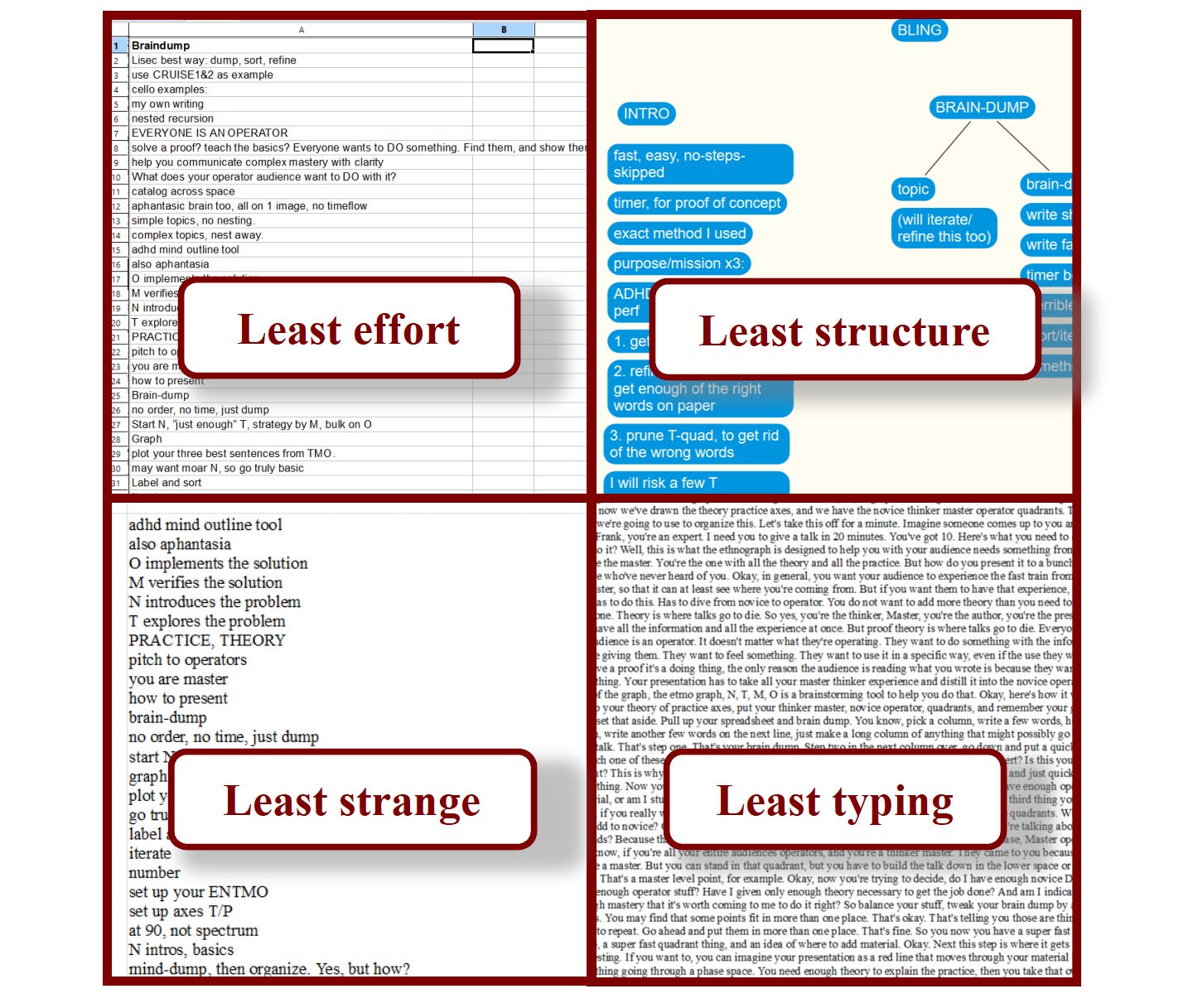
You can try any (or all) of these:
Least effort. Type ideas directly into a single spreadsheet column; OR
Least structure. Type into your favorite word-cloud software; OR
Least strange. Type into your favorite text engine; OR
Least typing. Record yourself speaking, copy/paste the transcript into an LLM, and ask it to generate a list of unique ideas.
Use whatever feels good.
You’ll be copy-pasting your brain-dump into a spreadsheet anyway.
Format time: 1 minute
Total time: 2 minutes
2.3: Brain-dump for speed
For the next two minutes, jot down anything that comes to mind.
“Brain-dump a few terrible ideas onto a blank page.”
What is your big idea? What is it about? Who needs it? What can they expect to do with it? How does it work?
“Write short. Write fast. Don’t edit.”
What are some of your favorite bits? Main pieces? Core concepts? Proofs? Generalities? Examples? Funny stories?
”One idea per line.”
Aim to generate at least 60 ideas in two minutes.
Then, once you have finished,
Copy your entire brain-dump.
Paste it into a single spreadsheet column.
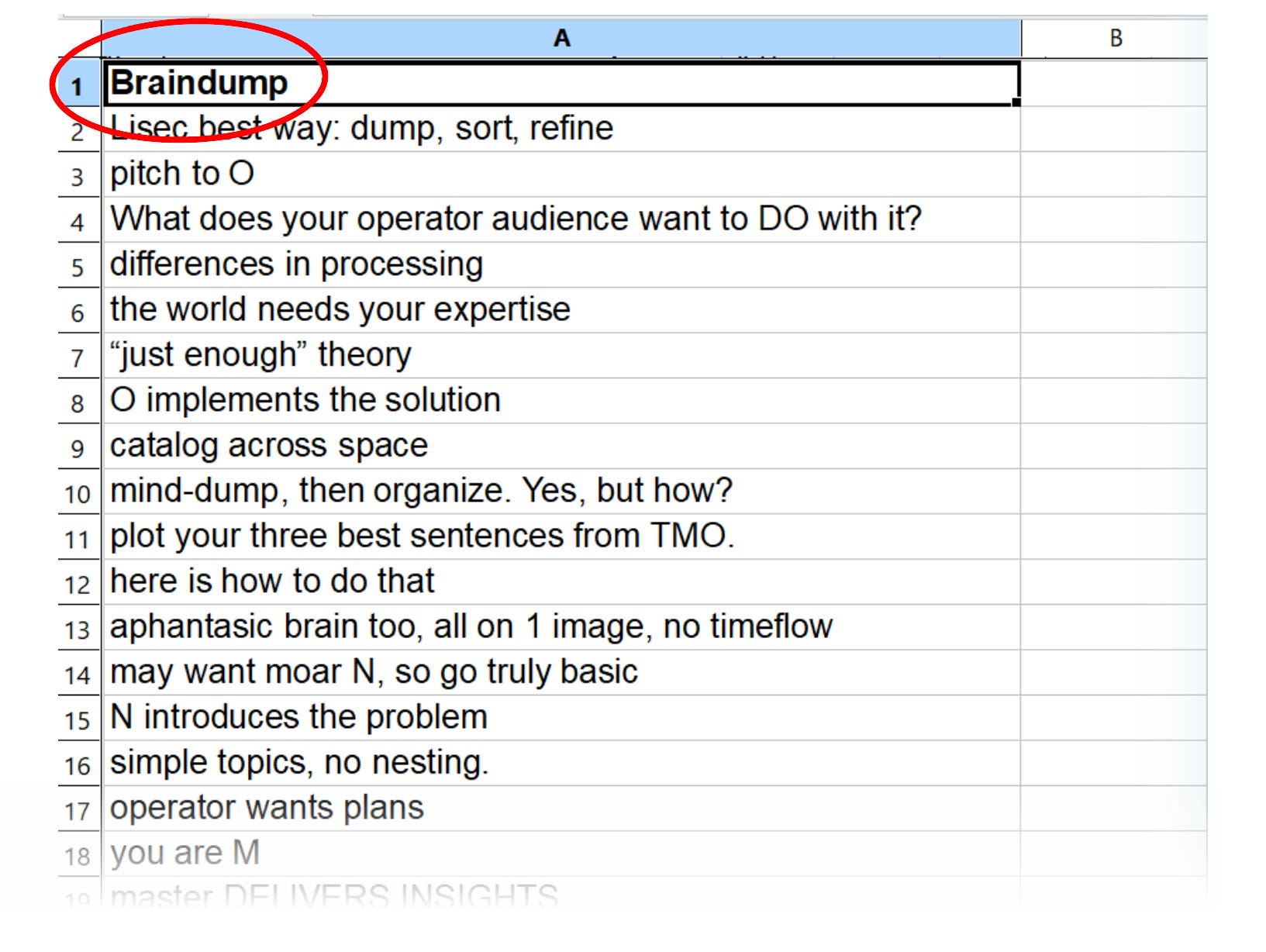
Brain-dump time: 2 minutes
Copy-paste time: 10 seconds
Total time: 4 minutes
2.4: Label your ideas
ENTMOgraph gives you five idea-labeling options: “E, N, T, M, and O.”
Examples (E) are helpful illustrations, analogies, or vivid clarifying instances. “Like a rabbit’s ears.” Examples get an easy ‘E.’
Novice basics (N) are simple introductions, definitions, or descriptions. “What is this?” Basically, anything you can use in the first five seconds of conversation.
Thinker proofs (T) are abstractions. Rich concepts, deep background, formal logic, technical terminology, and more. “How do we know?” Put a “T’ on ideas that need further explaining.
Master insights (M) are “Aha!” moments. Short, experience-based reframes that instantly change people’s minds. “Oh, I get it!” M’s let your expertise shine.
Operator plans (O) are clear, no nonsense, step-by-step instructions. “Ignore this.” “Do that next.” “Start here.” If it has an action verb, give it an ‘O.’
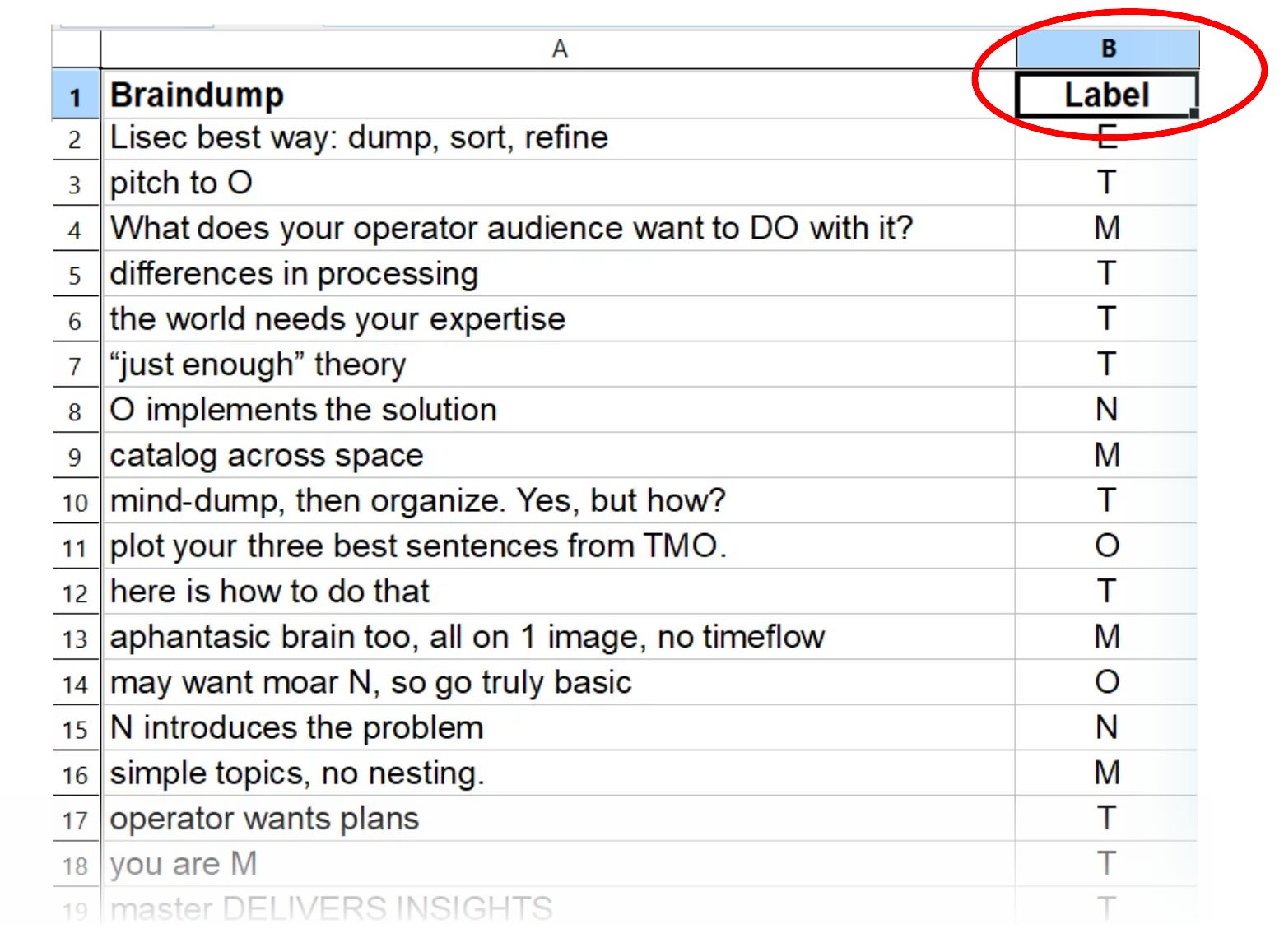
Here are a few helpful tips to keep you moving:
Label ideas, not words. Don’t be fooled by your own shorthand. If it could have an action verb, give it an ‘O.’
If multiple labels fit, duplicate the line (and label it more than one way).
If none fit, leave the line blank.
If you can’t decide, skip over the line and come back to it later.
You want speed, not precision. Don’t overthink it.
Label time: 3 minutes
Total time: 7 minutes
2.5: Sort by label
(Why a spreadsheet? Because spreadsheets are great sorters.)
Once you have finished labeling your ideas,
Save a backup
Select both columns A and B (“brain-dump” and “label”)
Sort by column B (“label”)
Now you can see each quadrant at a glance.
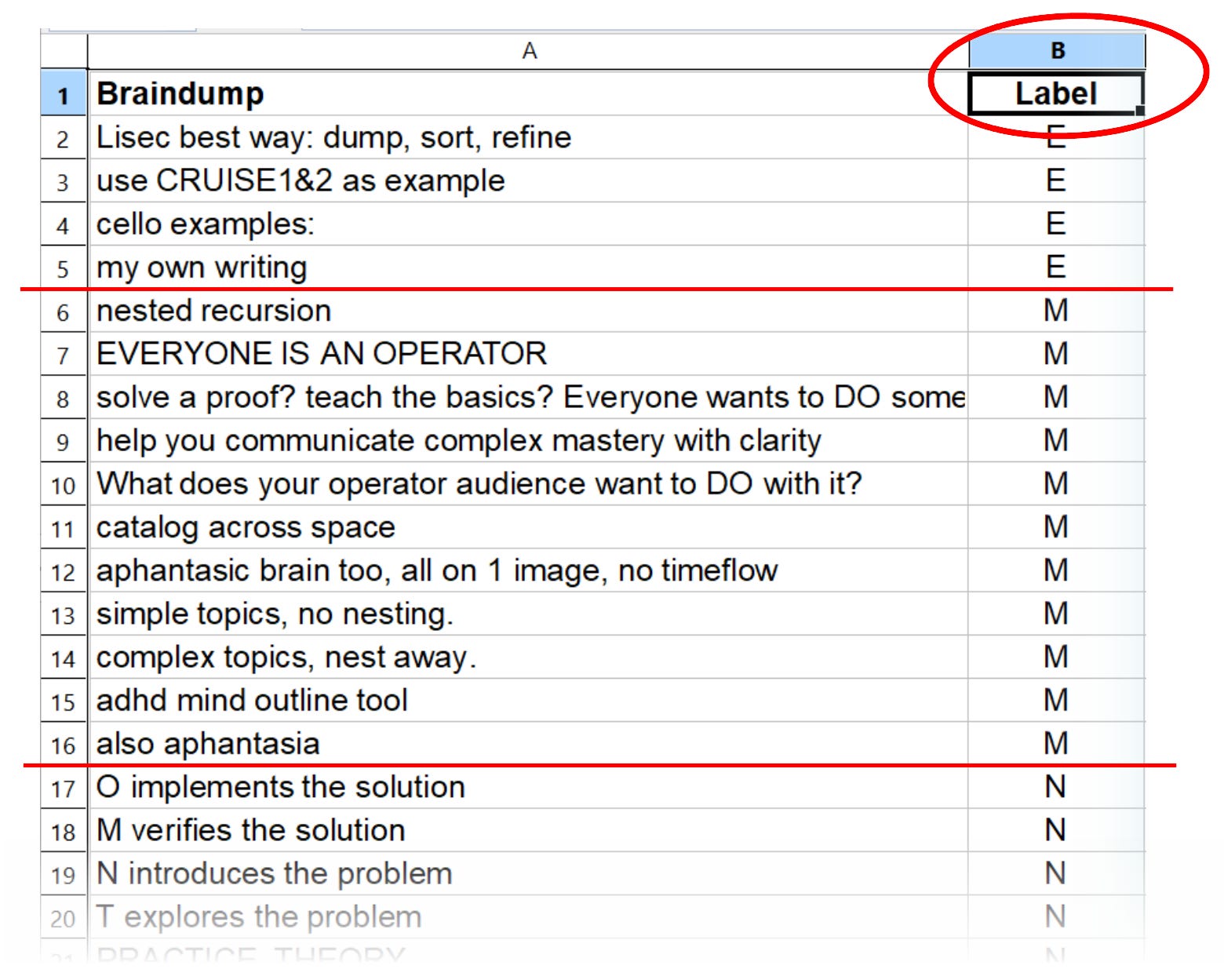
This, it turns out, is the key to everything that happens next.
Sort time: 10 seconds
Total time: still 7 minutes
Thanks for reading the first two chapters of my forthcoming e-book
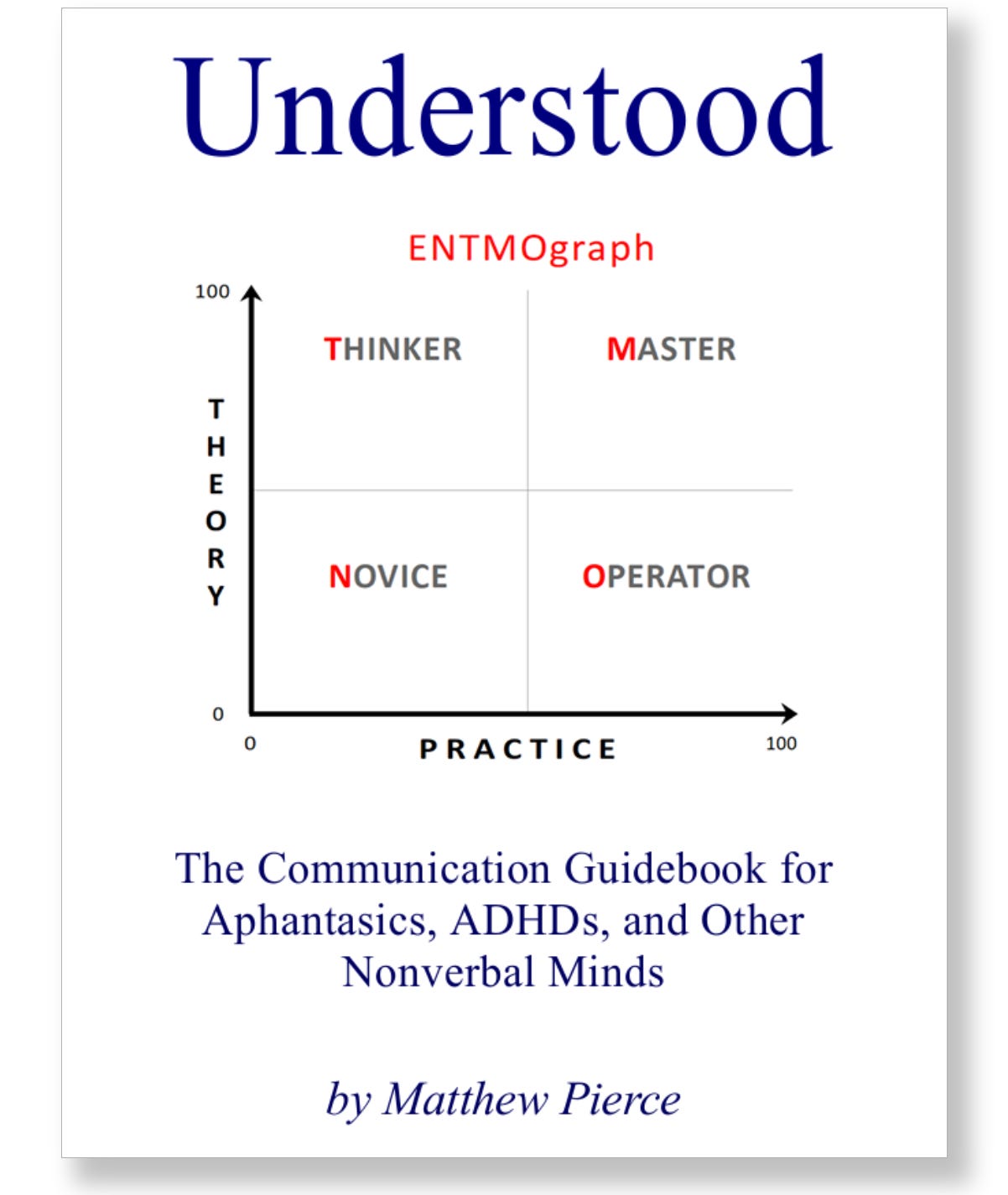
“Understood: The Communication Guidebook for Aphantasics, ADHDs, and Other Nonverbal Minds.”
You have now reached the end of the FREE SAMPLE.
If you would like to continue reading right now, head over to Gumroad and pre-order my book.
You will receive:
Instant access to Chapters 3 & 4
A locked-in lower price
The full e-book in September
Thank you for reading!
Follow me at @MJPiercello on X.
As always, subscribe for further updates.